


News & Articles

News & Articles

Collection of the latest news and articles related to IPR, trademarks, patents, and business development.


Find News & Articles

US Watch Brand Philip Stein Loses to `Counterfeit Goods`

23 - May - 2015
The American watch producer, Philip Stein Holding Inc, must admit its defeat. This is because the Supreme Court (MA) rejected its lawsuit against the locally made Philip Stein owned by Kasim Halim.
 
Philip Stein is a watch made at 169 East Flagler Street, Miami, Florida. The Philip Stein brand is registered in the US, Saudi Arabia, Hong Kong, Argentina, Austria, Benelux, Brazil, Canada, China, Colombia, Costa Rica, Egypt, Germany, Italy, Japan, Malaysia, Mexico, Morocco, and the UK. Later, the Philip Stein party was surprised to find a similar brand circulating in Indonesia produced by Kasim Halim. However, after checking, it turned out that Kasim Halim had obtained brand certificate number IDM 000174089.
 
"The first defendant, as an Indonesian citizen, should use brand names that clearly show Indonesian national identity and, as far as possible, avoid brand names that are similar, let alone plagiarize foreign brand names," stated Philip Stein in the cassation decision as reported by the Supreme Court (MA) website, Friday (22/5/2015).
 
This is in accordance with the Supreme Court's jurisprudence in case number 220/PK/Perd/1986 concerning the Nike brand. According to Philip Stein, watches with similarities create unfair competition, tricking or misleading consumers. On that basis, Philip Stein requested the Ministry of Law and Human Rights to revoke the brand certificate held by Kasim Halim.
 
The Ministry of Law and Human Rights responded to the lawsuit by stating that Philip Stein's lawsuit had expired. According to the Director General of Intellectual Property, Kasim Halim's brand was obtained on August 2, 2008, and the lawsuit was filed on September 13, 2013.
 
"In accordance with the provisions of Article 69 paragraph 1 of Law Number 15 of 2001 concerning trademarks, the plaintiff's lawsuit submission has expired," said the Ministry of Law and Human Rights in its response to the lawsuit.
 
However, Philip Stein's lawsuit failed. On December 10, 2013, the panel of judges at the Central Jakarta District Court (PN Jakpus) rejected Philip Stein's lawsuit entirely. Not accepting this, Philip Stein then filed for cassation. What did the Supreme Court say?
 
"It turns out that the brand declared by the plaintiff cannot be qualified as a famous brand because it is only registered in 4 countries, while in several countries submitted as proof, the registration has not yet received approval/approval from the authorities," said the cassation panel in its considerations.
 
The panel was chaired by Djafni Djamal with members Mahdi Soroinda Nasution and Nurul Elmiyah. On that basis, the panel rejected Philip Stein's cassation.
 
"The cassation applicant is ordered to pay court costs at the cassation level amounting to Rp 5 million," ruled the panel unanimously on August 27, 2014.
 
Source: detik.com

read: 15029 times

TAG :

Philip Stein
 

Others News & Articles

1 2 3 4 5 6 »
 

Copyright as an Intangible Movable Property: Understanding Tangible and Intangible Value

By: Dr. Ichwan Anggawirya, S.Sn., S.H., M.H. In Intellectual Property law practice, one of the most common misconceptions is the view that possession of a physical object is identical to possession of all rights attached to that object. For example, purchasing a painting is often understood as a basis for reproducing that painting. Similarly, receiving the source code of a computer...

Copyright, Creator, and Ownership of Computer Programs in the Indonesian Legal Perspective

Dr. Ichwan Anggawirya, S.Sn., S.H., M.H. One of the fundamental issues that often leads to disputes in copyright law practice is the lack of clear understanding regarding the relationship between the party financing the creation of a work, the party creating the work, and the party entitled to economic benefits from it. In business practice, these three concepts are often treated as...

When Form Becomes Identity: Understanding 3D Brands and Industrial Design in Branding Strategy

  Dr. Ichwan Anggawirya, S.Sn., S.H., M.H. The development of intellectual property law shows that the identity of a trademark is no longer limited to just a name, writing, or two-dimensional logo. In commercial practice, certain product shapes and packaging often have a stronger distinctive power than the brand name itself. Consumers in many situations can recognize the origin of...

Why is it difficult for the law to provide an absolute definition of a famous mark

  Dr. Ichwan Anggawirya, S.Sn., S.H., M.H. The concept of a "well-known mark" is one of the most important concepts in trademark law, yet it is also one of the most difficult to define absolutely. Almost all trademark legal systems in various countries recognize it as a basis for broader legal protection for a mark that has a strong reputation. However, interestingly,...

The Importance of Intellectual Property Due Diligence in Companies: Trademarks, Patents, Designs, Co

Dr. Ichwan Anggawirya, S.Sn., S.H., M.H. Many companies still view physical assets such as buildings, machinery, inventory, and financial reports as the primary measures of business strength. However, in the current economic development, a company's value is increasingly determined by its intellectual property. In many global companies, the most valuable assets are no longer tangible...

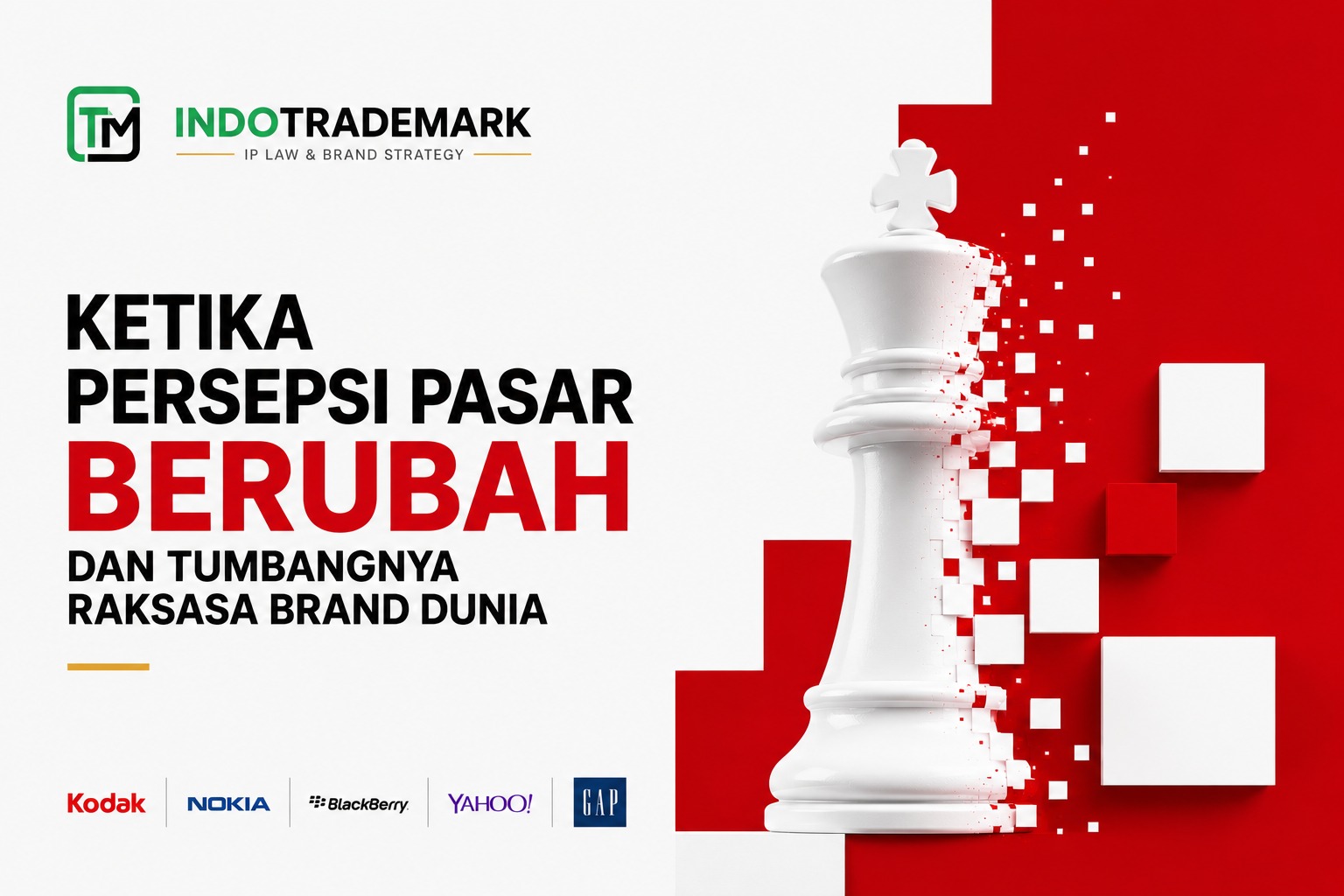
When Market Perceptions Change and Global Brand Giants Fall

  Dr. Ichwan Anggawirya, S.Sn., S.H., M.H. Not a few major global brands were once considered too strong to be defeated. These names not only dominated the market but also shaped consumption culture, social status symbols, and even the identity of certain generations. However, business history shows that no matter how strong a brand's power, it can still decline when companies...

Brand as a Composition: Harmony of Sound, Color, Form, and Social Resonance in Architecture

Dr. Ichwan Anggawirya, S.Sn., S.H., M.H. When dissected more deeply, a brand is not merely a trade name or a visual symbol that functions to differentiate one product from another. In a much more complex dimension, the process of brand formation is actually very similar to the birth of a musical work. Just as a song is composed through the harmony of notes, rhythm, tempo, emotional...

Viral Brands Are No Accident: Branding Entry Strategies in Creating Market Explosions

Dr. Ichwan Anggawirya, S.Sn., S.H., M.H. Not a few people assume that a brand goes viral solely due to luck, social media momentum, or a fleeting trend. However, in contemporary branding practices, virality is often the result of a perception strategy consciously designed from the outset. Some brands are even intentionally shaped to become public talking points before their products are...

Brands as Modern Religions: When Brands Become Social Belief Systems

Dr. Ichwan Anggawirya, S.Sn., S.H., M.H. In classical business theory, brands are generally understood as commercial identities that function to differentiate the goods or services of one business entity from those of another. However, in contemporary branding practices, some of the world's major brands have evolved far beyond the mere function of product identification. At a...

Intentionally "Wrong" but Strong Brand Name Strategies

Dr. Ichwan Anggawirya, S.Sn., S.H., M.H. In contemporary branding practices, there is an interesting phenomenon where some companies build their brand identity through words that are linguistically considered non-standard, unusual, or appear as deviations from commonly known spellings. Although often perceived as a form of writing "error," such modifications are in fact...

Need a Free Consultation?

Our expert team is ready to help you choose the right services for your business needs