


News & Articles

News & Articles

Collection of the latest news and articles related to IPR, trademarks, patents, and business development.


Find News & Articles

Supreme Court Wins New Warehouse

22 - February - 2015

Jakarta - The brand dispute between Gudang Garam and Gudang Baru has concluded with the Supreme Court judges Vallerina JL Kriekhoff and colleagues. The cassation panel ruled that the two brands do not share similarities in form, placement, and pronunciation.

Gudang Baru was represented by former State Secretary, Yusril Ihza Mahendra. 

"The Gudang Baru kretek cigarettes are made for a distinct market segment," said Yusril, as stated on page 28 of the cassation decision published on the MA website, Friday (7/11/2014).

Gudang Baru had initially lost at the Commercial Court of Surabaya in 2013. However, upon filing for cassation, the request from Gudang Baru, located in Pasuruan, was granted. The case, bearing number 162 K/Pdt.Sus-HKI/2014, was presided over by Chief Justice Prof Dr Valerina JL Kriekhoff with members Soltoni Mohdally and Abdurrahman.

"If Gudang Baru kretek cigarettes are no longer produced, the public will have no alternative choice for competitively priced kretek cigarettes other than Gudang Garam products. Yet, Gudang Baru kretek cigarettes are affordable and cater to their own consumer segment," said Yusril.

Yusril also regretted Gudang Garam's action of suing his client after the Gudang Baru company had grown significantly. According to Article 69 paragraph 2 of the Trademark Law, trademark lawsuits must be filed within a maximum of 5 years after the defendant's trademark is registered.

"The plaintiff's action of not having a time limit to file a lawsuit aims to seize and plunder Gudang Baru's consumers. Therefore, the cancellation of the Gudang Baru trademark is a veiled form of unhealthy business competition," Yusril stated.


Source: detik.com

read: 20071 times

TAG :

Gudang Garamnew warehouse
 

Related News & Articles

Others News & Articles

1 2 3 4 5 6 »
 

Copyright as an Intangible Movable Property: Understanding Tangible and Intangible Value

By: Dr. Ichwan Anggawirya, S.Sn., S.H., M.H. In Intellectual Property law practice, one of the most common misconceptions is the view that possession of a physical object is identical to possession of all rights attached to that object. For example, purchasing a painting is often understood as a basis for reproducing that painting. Similarly, receiving the source code of a computer...

Copyright, Creator, and Ownership of Computer Programs in the Indonesian Legal Perspective

Dr. Ichwan Anggawirya, S.Sn., S.H., M.H. One of the fundamental issues that often leads to disputes in copyright law practice is the lack of clear understanding regarding the relationship between the party financing the creation of a work, the party creating the work, and the party entitled to economic benefits from it. In business practice, these three concepts are often treated as...

When Form Becomes Identity: Understanding 3D Brands and Industrial Design in Branding Strategy

  Dr. Ichwan Anggawirya, S.Sn., S.H., M.H. The development of intellectual property law shows that the identity of a trademark is no longer limited to just a name, writing, or two-dimensional logo. In commercial practice, certain product shapes and packaging often have a stronger distinctive power than the brand name itself. Consumers in many situations can recognize the origin of...

Why is it difficult for the law to provide an absolute definition of a famous mark

  Dr. Ichwan Anggawirya, S.Sn., S.H., M.H. The concept of a "well-known mark" is one of the most important concepts in trademark law, yet it is also one of the most difficult to define absolutely. Almost all trademark legal systems in various countries recognize it as a basis for broader legal protection for a mark that has a strong reputation. However, interestingly,...

The Importance of Intellectual Property Due Diligence in Companies: Trademarks, Patents, Designs, Co

Dr. Ichwan Anggawirya, S.Sn., S.H., M.H. Many companies still view physical assets such as buildings, machinery, inventory, and financial reports as the primary measures of business strength. However, in the current economic development, a company's value is increasingly determined by its intellectual property. In many global companies, the most valuable assets are no longer tangible...

When Market Perceptions Change and Global Brand Giants Fall

  Dr. Ichwan Anggawirya, S.Sn., S.H., M.H. Not a few major global brands were once considered too strong to be defeated. These names not only dominated the market but also shaped consumption culture, social status symbols, and even the identity of certain generations. However, business history shows that no matter how strong a brand's power, it can still decline when companies...

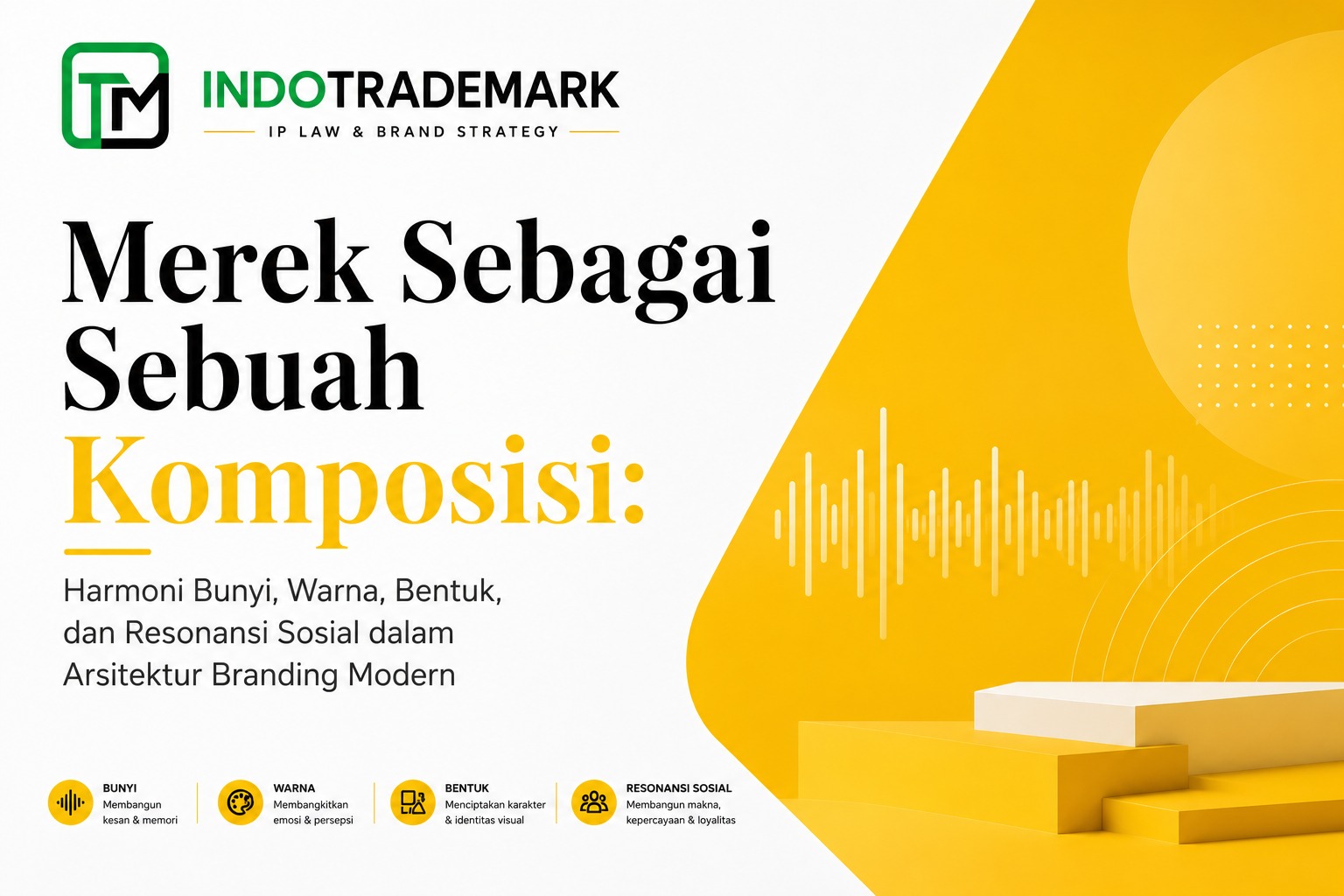
Brand as a Composition: Harmony of Sound, Color, Form, and Social Resonance in Architecture

Dr. Ichwan Anggawirya, S.Sn., S.H., M.H. When dissected more deeply, a brand is not merely a trade name or a visual symbol that functions to differentiate one product from another. In a much more complex dimension, the process of brand formation is actually very similar to the birth of a musical work. Just as a song is composed through the harmony of notes, rhythm, tempo, emotional...

Viral Brands Are No Accident: Branding Entry Strategies in Creating Market Explosions

Dr. Ichwan Anggawirya, S.Sn., S.H., M.H. Not a few people assume that a brand goes viral solely due to luck, social media momentum, or a fleeting trend. However, in contemporary branding practices, virality is often the result of a perception strategy consciously designed from the outset. Some brands are even intentionally shaped to become public talking points before their products are...

Brands as Modern Religions: When Brands Become Social Belief Systems

Dr. Ichwan Anggawirya, S.Sn., S.H., M.H. In classical business theory, brands are generally understood as commercial identities that function to differentiate the goods or services of one business entity from those of another. However, in contemporary branding practices, some of the world's major brands have evolved far beyond the mere function of product identification. At a...

Intentionally "Wrong" but Strong Brand Name Strategies

Dr. Ichwan Anggawirya, S.Sn., S.H., M.H. In contemporary branding practices, there is an interesting phenomenon where some companies build their brand identity through words that are linguistically considered non-standard, unusual, or appear as deviations from commonly known spellings. Although often perceived as a form of writing "error," such modifications are in fact...

Need a Free Consultation?

Our expert team is ready to help you choose the right services for your business needs